

The Silent Majorities: six groups across society whose views point to systemic change
Expressing our shared concerns can drive public confidence in systems change.

A major barrier to tackling climate change—and and the general mess society is in—is that people feel much more alone with their hopes and fears than they really are.
Our latest report, Mobilising Silent Majorities, shows how much people do care—but too often, don’t speak up. And that silence is slowing down the possibility of large-scale change.
Breaking the Silence
Dr. Liam Kavanagh, CMP co-Director, explains:
“The central obstacle is not disbelief or indifference… Silence becomes a rational response—but as those concerns become visible, it may only be a matter of time before the majority who wants deep change recognises itself.”
Even small acts of public expression can create cascading effects—suddenly, concerns that felt isolated become a visible force. History shows this can happen: from trade unions to #MeToo, societal change often starts when people realise they are not alone.
Caroline Lucas, former Green Party MP and advisor to the project, adds:
“Recognising that we are not alone could be an important step toward the collective response the moment demands.”
Six Silent Majorities
Across society, many people recognise serious risks—climate disruption, inequality, instability—but these concerns often stay private. The report identifies six “silent majorities” whose hidden views could shift what feels politically possible:
The climate-concerned majority – Most people see climate change as a serious threat but rarely talk about it in daily life.
The climate-concerned business majority – Business leaders see climate risks but hesitate to speak publicly.
The reticent scientific majority – Scientists privately worry about worst-case scenarios but communicate cautiously.
The decline- and collapse-concerned majority – Many fear overlapping crises, yet these concerns are rarely voiced.
The depolarising majority – Citizens who favour cooperation over conflict are often drowned out by louder, polarising voices.
The intrinsic-values majority – People prioritise family, community, and wellbeing, but economic pressures often prevent these values from guiding their lives.
When concern remains unspoken, it appears weaker than it is. And when people feel alone in their worries, silence becomes the apparently safest choice.
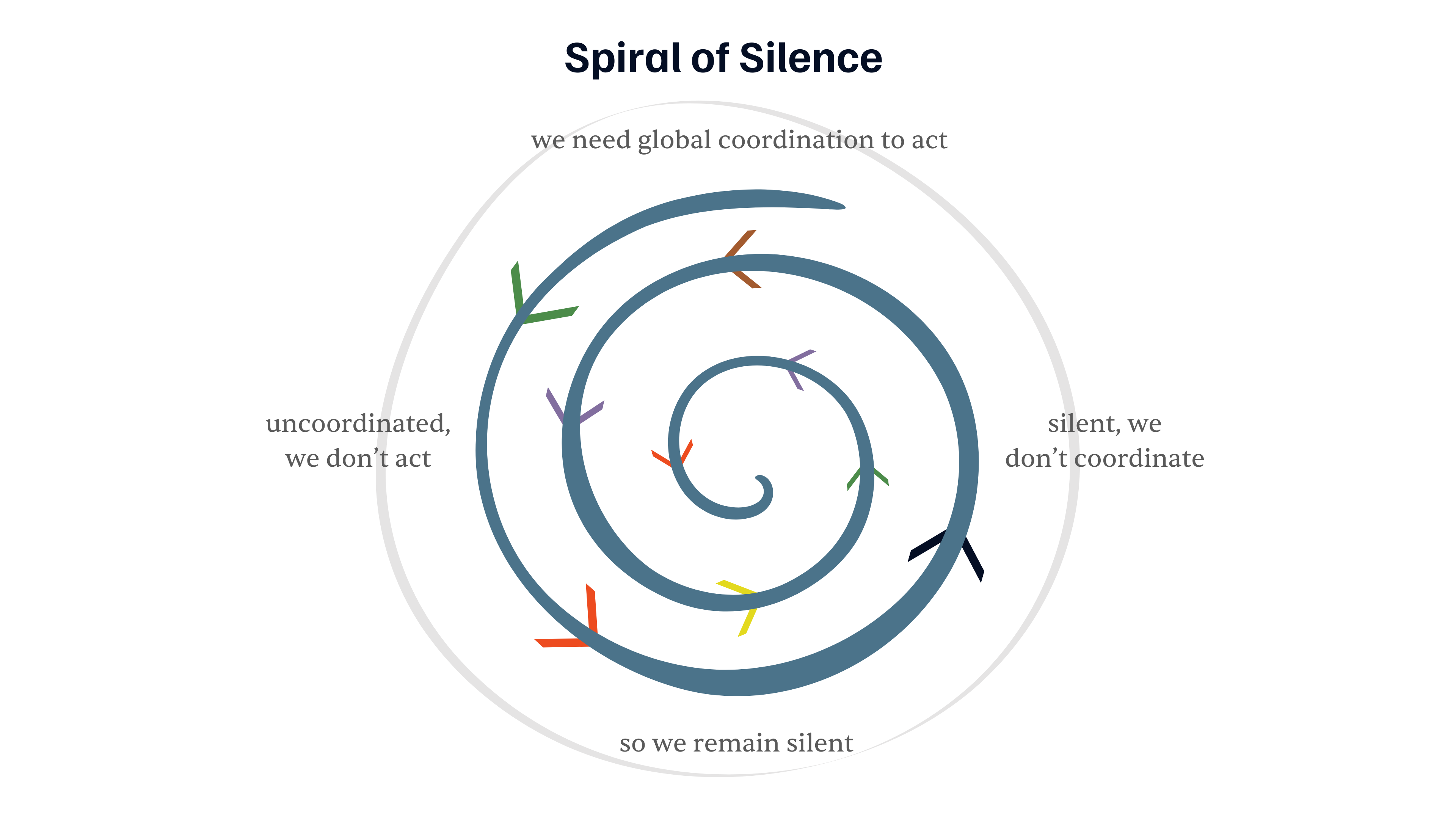
As illustrated in the Mobilising Silent Majorities report.
How Change Could Happen
The report highlights practical ways to bring these silent majorities into the open:
Open scientific communication that doesn’t downplay risks
Unexpected voices speaking up Business leaders, civic institutions, and local actors can legitimise concern
Practical responses to climate risk, including by building community adaptation and resilience
The idea is simple: concern is already widespread. Once it becomes visible, public confidence in systemic change can grow fast.
Get Involved
Start conversations about climate and systemic risks with your community.
Share media (including articles like this!) that helps make these silent majorities aware of themselves in your community or organisation.
Help younger generations break the spiral of silence by donating to our climate courage schools campaign.
Yes
This report deserves to be shared widely, employees, businesses, councillors and academics esp . No ideology - directed/created from tiny power elite , nor top - down government employing it , will alter status quo path we are on.